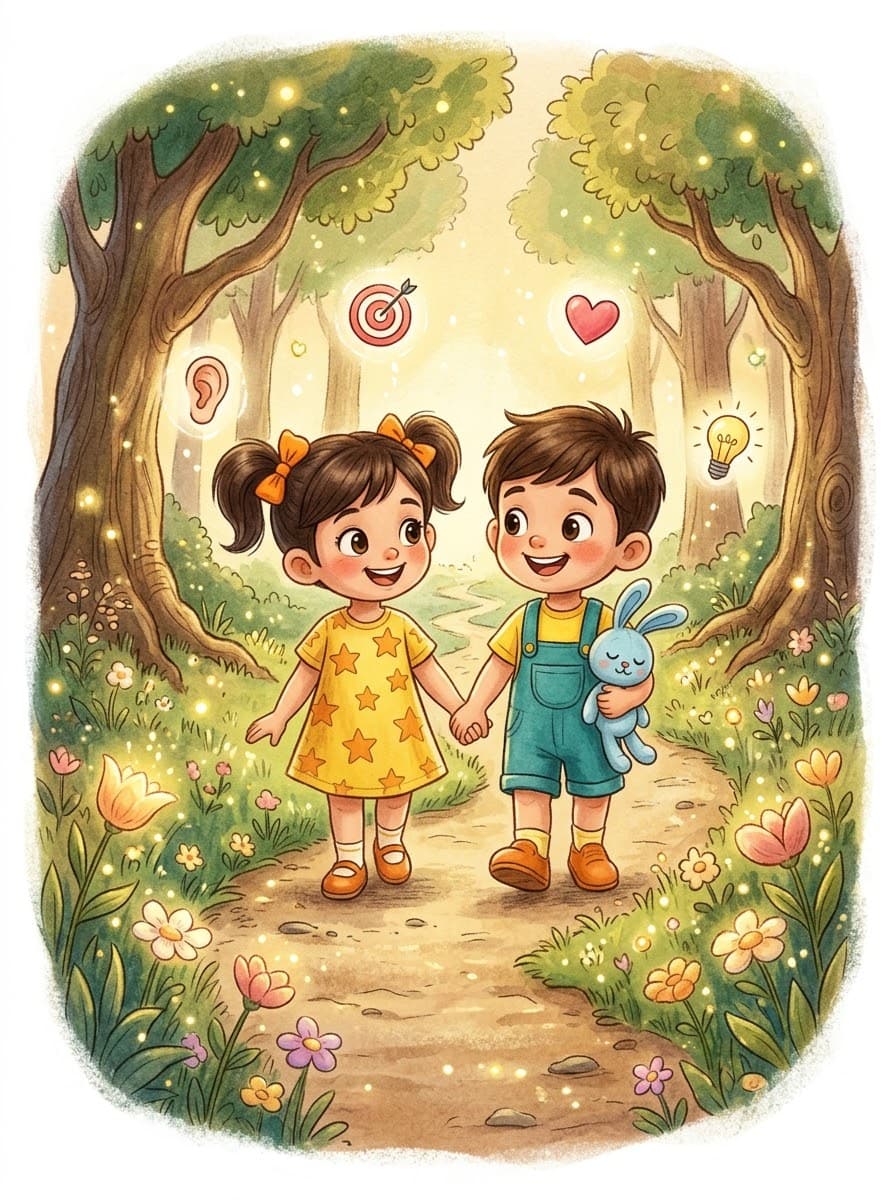
Every story a child hears asks their brain to do four things at once: listen, focus, feel, and think. Here's how storytelling actually works as a development tool, pillar by pillar, and how personalisation makes each one stronger.
Storytelling helps children develop in four connected ways: it builds listening skills through following spoken narrative, strengthens attention and focus by giving the brain a reason to stay engaged, develops emotional intelligence by letting children experience feelings through a character, and grows cognitive skills like memory, sequencing, and cause-and-effect reasoning. These four pillars, listening, attention, emotional intelligence, and cognitive growth, aren't separate benefits of storytelling. They happen together, in every story, every time.
Parents are often told that reading to children is "good for them" without much explanation of what that actually means. It's a vague enough claim that it's easy to nod along to and hard to act on. So here is the more specific version: what is a child's brain actually doing when they listen to a story, and what does that have to do with how they grow?
Why storytelling isn't just entertainment
A story is not passive content in the way a video often is. To follow a story, even a simple one, a child has to hold a sequence of events in mind, track who is doing what and why, notice how characters feel, and predict what might happen next. That's a genuine cognitive workout, wrapped in something that feels like fun rather than effort.
This is the core idea behind Lalli Fafa's four pillars: listening skills, attention and focus, emotional intelligence, and cognitive growth. They aren't marketing categories. They're the four things a child's brain is actually doing, simultaneously, every time they listen to a well-told story.
👂 Listening skills: following a story is a practised skill
Listening comprehension, the ability to follow spoken language, hold it in working memory, and make sense of it, is a skill that develops through repetition, not instruction. You can't teach a three-year-old to listen better by explaining listening. You build the skill by giving them rich spoken language to practise on, over and over, in a form they want to keep coming back to.
This is where narrated stories do something a picture book alone can't: they isolate listening as the primary channel. Without pictures to lean on, a child has to construct meaning from sound and language alone, which is a more demanding, and more skill-building, form of comprehension practice.
We go deeper on the practical side of this, including how to read aloud in a way that actually holds a young child's attention, in how to read aloud to your child by age and stage.
🎯 Attention & focus: relevance is what keeps a young brain engaged
Attention in young children is not a fixed capacity that some children have more of than others. It's highly responsive to relevance. A child who seems unable to sit still for a generic cartoon can often sit rapt through a story that speaks directly to something they care about: their name, their interests, a fear they're working through.
This is one of the reasons personalisation matters more than it might first appear. A story doesn't have to be louder or faster to hold a child's attention. It has to be more relevant. When a child hears their own name, their own favourite animal, or a challenge that feels like their own, the brain's relevance filter opens wider, and attention follows.
We've written a full research-based look at this, including how screen time and attention span actually relate to each other, in screen time and attention span: what the research actually says.
❤️ Emotional intelligence: stories let children feel things safely
Emotional intelligence, recognising feelings, understanding what causes them, empathising with others, and managing your own reactions, is not something children learn from being told about it. It's built through repeated, low-stakes practice at encountering feelings and making sense of them.
A story gives a child exactly that kind of practice. When a character feels scared, embarrassed, proud, or left out, and the story shows what that feels like and what the character does about it, the child gets to rehearse the emotional experience without having to live through the real version first. Over many stories, this rehearsal adds up to something real: a working vocabulary for feelings, and a mental library of how those feelings tend to resolve.
We've written specifically about how bedtime stories build this skill in how bedtime stories build emotional intelligence, and about the practical, in-the-moment side of talking with your child about feelings in how to talk to your child about feelings.
🧠 Cognitive growth: stories are reasoning practice in disguise
Every story, even a simple one, is built from cause and effect: something happens, a character responds, and that response leads somewhere. Following that chain requires memory (what happened earlier), sequencing (what order things occurred in), and prediction (what's likely to happen next). These are not story-specific skills. They're the same reasoning skills children use in maths, in planning, and in everyday problem solving.
This connection between storytelling and academic outcomes isn't just intuitive, it shows up in research. A study of over 6,700 children in Ghana found that children who were regularly told stories were significantly more likely to be on track for literacy and numeracy development than children who weren't (adjusted odds ratio 1.61, 95% CI 1.26 to 2.04). Worth noting: the same study found no significant link between storytelling and other outcomes like social-emotional development, which is a useful reminder that stories aren't a cure-all for everything. What they reliably build is the specific reasoning and language scaffolding that literacy and numeracy depend on.
We go deeper on this, stage by stage, in cognitive development milestones ages 2 to 5.
Why personalisation strengthens all four pillars at once
Here's the connecting thread across all four pillars: a story that features your child, by name, with their actual interests and personality, doesn't just add novelty. It raises the stakes on every one of the four mechanisms above. A child listens more closely to a story about themselves. They pay more attention because it's relevant to them specifically. They feel more, because the character's experience is framed as their own. And they reason more actively, because they're not just watching a plot unfold, they're inside it.
We've written in more depth about why this matters in why your child being the hero of a story matters more than you think, and about how personalised stories compare to regular storybooks in personalised stories vs. regular storybooks.
What this means for story time, practically
You don't need to overhaul your child's bedtime routine to put this into practice. The core idea is simple: choose stories that ask something of your child's brain, not just their eyes and ears. A story with real narrative structure, a character with real feelings, and something for your child to follow and predict is doing all four kinds of developmental work at once, whether it's a picture book you read aloud, an audio story, or a personalized story where your child is the one having the adventure.
This is the thinking behind how we built Lalli Fafa: every story is narrated (for listening), built around your child specifically (for attention and emotional investment), structured around a real lesson and a character's genuine feelings (for emotional intelligence), and built on a clear narrative arc your child can follow and predict (for cognitive growth). Not because storytelling needs to be complicated, but because a good story was already doing all four things. We just tried to make sure nothing gets in its way.
Common questions
How does storytelling help child development?
Storytelling supports child development across four connected areas: listening skills, built through following spoken narrative; attention and focus, built through sustained engagement with a relevant story; emotional intelligence, built through experiencing feelings alongside a character; and cognitive growth, built through following sequences, cause and effect, and prediction. These four things happen together in almost any well-told story, not as separate, isolated benefits.
What skills does storytelling teach children?
Storytelling builds listening comprehension, sustained attention, emotional vocabulary and empathy, memory, sequencing, and reasoning about cause and effect. It also supports vocabulary development and, for personalised stories specifically, a stronger and more positive self-concept.
Is storytelling actually linked to academic outcomes like literacy and numeracy?
There is real evidence for this specific link. A study of over 6,700 children in Ghana found that regular storytelling was associated with significantly higher odds of being on track for literacy and numeracy development (adjusted odds ratio 1.61). The same study found no significant association between storytelling and other outcomes such as social-emotional development, so the effect appears specific to literacy and numeracy rather than a general boost to everything.
Does it matter if a story is personalised or generic?
Personalisation doesn't replace the four pillars, it strengthens all of them at once. A child listens more closely, pays more attention, feels more, and reasons more actively about a story built around themselves specifically, compared to a generic story with an unfamiliar protagonist. Personal relevance is one of the strongest levers for attention and emotional engagement in young children.
What age should storytelling start?
There's no age that's too early. Children respond to the rhythm and warmth of a parent's voice from birth, well before they understand individual words. What a story does for a child changes as they grow, from rhythm and comfort in infancy, to vocabulary building as toddlers, to moral reasoning and empathy from around age three onward. We cover this stage by stage in our guide to reading aloud by age.
Do audio stories build these same skills, or only picture books and read-alouds?
Audio stories are particularly effective for the listening pillar specifically. Since there are no pictures to lean on, a child has to construct meaning from language alone, which is a more demanding form of listening practice. The other three pillars, attention, emotional intelligence, and cognitive growth, depend more on the story's content and structure than on its format.
Raj Kothari
Founder, Lalli Fafa — building magical, personalised stories for children across India.
Put this into practice tonight
Create a personalised story for your child — free, in under 2 minutes.