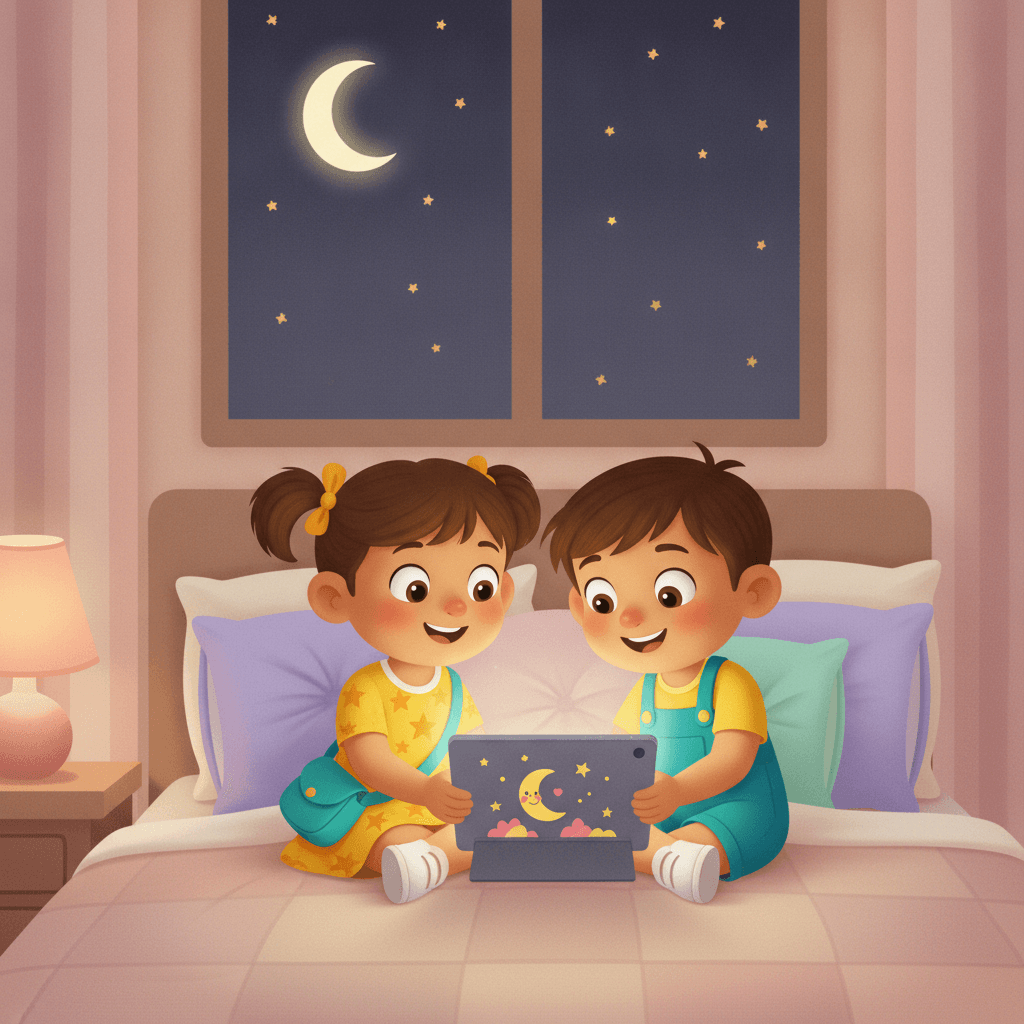
Not all story apps are built the same. Here's a simple checklist — backed by what actually matters for sleep, language, and screen-time guilt — to help you choose well.
The best bedtime story apps for kids in India share four traits: real personalisation (your child is the hero, not just a name swapped into a template), genuine bilingual narration in English and Hindi (not subtitles bolted onto English audio), calm pacing designed for sleep rather than excitement, and a completely ad-free experience with no autoplay into unrelated content. If an app is missing more than one of these, it's probably not built for bedtime — it's built for engagement metrics.
With so many "kids learning" and "story time" apps now available, it's worth being deliberate about what you let into the last 20 minutes of your child's day. That window matters more than almost any other part of the routine. Here's what to actually look for.
1. Personalisation — is your child actually in the story?
There's a meaningful difference between an app that lets you type your child's name into a generic story, and one that builds the story around your child — their interests, their age-appropriate challenges, their personality traits.
A quick test: does the app ask you anything about your child beyond their name? If the only personalisation field is "Child's Name," the story is a template with a find-and-replace. If it asks about favourite animals, colours, a sibling's name, or what your child is working on (sharing, courage, trying new foods), the story is being built around your child specifically — and that's where the real benefit lives. (We go deeper on why this distinction matters in personalised stories vs. regular storybooks.)
2. Real bilingual narration, not just subtitles
For bilingual Indian families, "available in Hindi" can mean very different things. Sometimes it means the on-screen text is translated while the narration stays in English. Sometimes it means a robotic text-to-speech voice that mispronounces half the words. And sometimes — increasingly — it means a genuinely separate Hindi narration, recorded or generated with native pronunciation, pacing, and warmth.
The difference is obvious within the first ten seconds of listening. If it sounds like a translation being read aloud, it is. If it sounds like a story that was always meant to be told in Hindi, it was made properly.
3. Calm narration, paced for sleep
This is the one most "educational" apps get backwards. Apps designed for daytime learning often use upbeat, energetic narration — fast pacing, exaggerated voices, sound effects on every page. That's exactly wrong for 7 PM.
A good bedtime story app uses a slower pace, warmer tone, and quieter sound design. The narration should feel like it's gently bringing energy down, not up. If your child seems more awake after a story than before, the app's pacing is part of the problem.
4. No ads, no "watch next," no autoplay
This one is non-negotiable, and not just for the obvious reasons. The moment a story ends and an ad — or a "you might also like" carousel of unrelated videos — appears, the calm, narrative, sleep-preparing state your child was just in gets interrupted by exactly the kind of stimulating content you were trying to avoid.
Look for apps where a story ends and... nothing happens. No prompt, no next video, no notification. Just quiet. That silence is doing real work.
5. Audio-first, so it doesn't have to be a screen battle
Some of the best story experiences for bedtime barely need a screen at all — once the story is playing, the device can go face-down on the nightstand. This matters for two reasons: it removes the blue-light problem entirely, and it sidesteps the negotiation over "five more minutes" that visual content tends to create.
If an app's stories work well as pure audio — narration good enough that your child doesn't need to be looking at anything — that's a strong signal it was actually designed with bedtime in mind, not just adapted for it.
A simple checklist
Before you commit to a story app for your child, ask:
- Does it ask about my child beyond just their name?
- Is the Hindi (or other language) narration genuinely native, not a translated read-aloud?
- Does the narration sound calm and slow, or energetic and quick?
- What happens when a story ends — silence, or more content?
- Could my child enjoy this with their eyes closed?
If you can answer those five questions confidently for an app, you've found something worth adding to the routine. This is exactly the bar we built Lalli Fafa to meet — personalised stories about your child, narrated calmly in English or Hindi, with nothing waiting at the end except a good night. See our plans to get started, or read about building a routine that survives a busy weekday.
Common questions
What makes a bedtime story app good for children in India?
The best bedtime story apps for children in India offer real personalisation where your child is the actual hero rather than a name-swap template, genuine bilingual narration in English and Hindi with native pronunciation, calm pacing designed to bring energy down rather than up, and a completely ad-free experience where nothing plays after the story ends.
Are there story apps for kids that support Hindi narration in India?
Yes, but the quality varies significantly. Look specifically for apps where the Hindi narration is native in quality — not a translation being read aloud, and not robotic text-to-speech. The difference is immediately obvious within the first ten seconds of listening. Well-built Hindi narration sounds like a story that was always meant to be told in Hindi.
Should bedtime story apps for children be ad-free?
Yes — this is non-negotiable for bedtime specifically. The moment a story ends and an ad or watch-next prompt appears, the calm, sleep-ready state your child was in gets interrupted by exactly the kind of stimulating content you were trying to avoid. A good bedtime story app ends with quiet, not more content.
Raj Kothari
Founder, Lalli Fafa — building magical, personalised stories for children across India.
Put this into practice tonight
Create a personalised story for your child — free, in under 2 minutes.