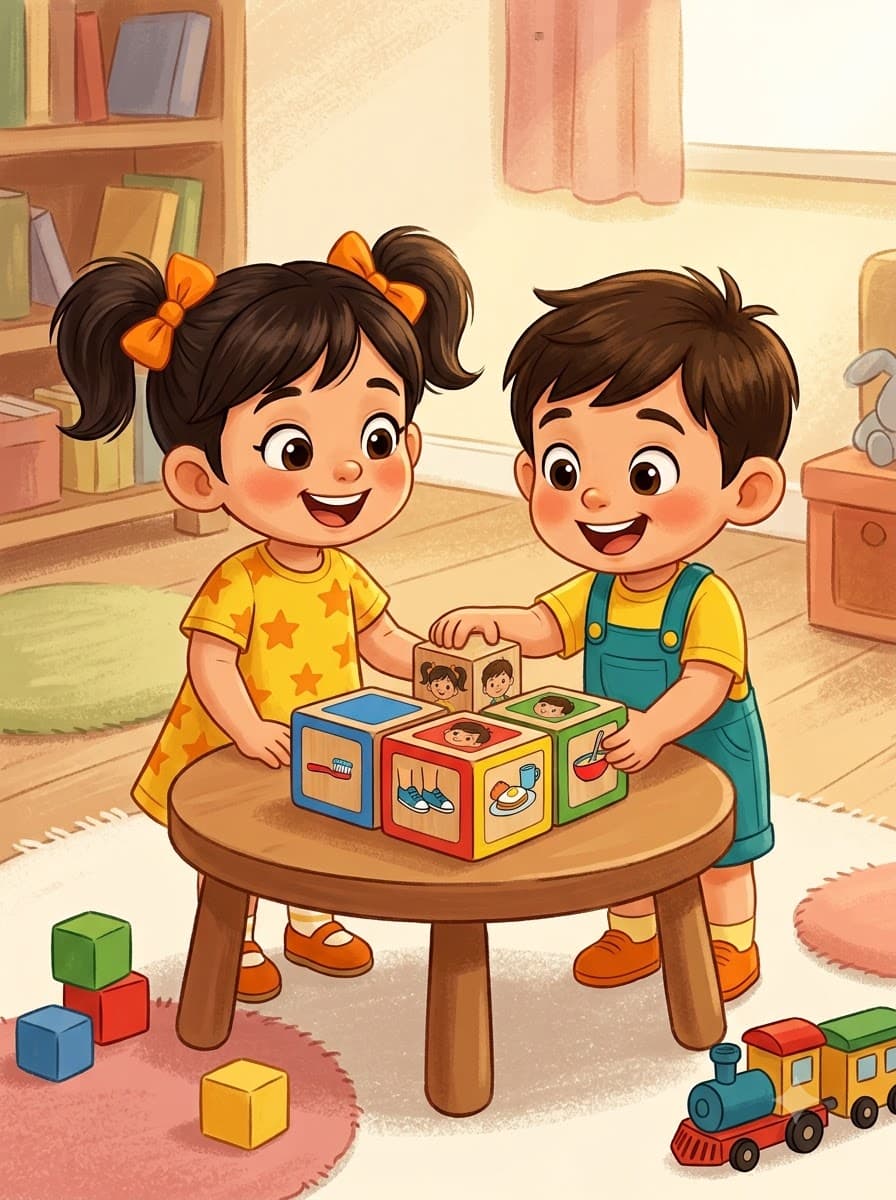
From first pretend play to first predictions about what happens next, here's what cognitive development actually looks like between ages 2 and 5, and where storytelling fits into each stage.
Between ages 2 and 5, children move from simple pretend play to genuine reasoning: understanding cause and effect, holding two ideas in mind at once, predicting outcomes, and starting to see the world from someone else's point of view. This period, which developmental psychologists broadly describe as the preoperational stage, is also when storytelling starts doing real cognitive work, not just entertaining a child, but giving their reasoning skills something to practise on daily.
Every child develops at their own pace, and the ranges below are broad guides, not a checklist to worry over. What's more useful than exact ages is understanding the general sequence: what tends to come before what, and what stories can offer at each point.
Age 2: symbols, pretend play, and first sequences
Two-year-olds are developing what psychologists call symbolic thinking, the ability to let one thing represent another. A block becomes a phone. A stuffed animal becomes a patient. This is a genuinely significant cognitive leap: it means a child can hold an idea in their mind that isn't physically in front of them.
You'll typically also see the beginnings of sequence understanding: a two-year-old can often follow a simple two-step story ("first this happened, then that happened") even if they can't yet retell it themselves. Repetition matters enormously at this age, hearing the same short story multiple times helps a child build a stronger internal model of its structure.
Where stories help: simple, short, highly repetitive stories with clear cause and effect ("Fafa touched the puddle, and his socks got wet") give two-year-olds exactly the kind of sequence practice their cognitive development is ready for.
Age 3: cause and effect, and the start of "why"
Three is often when the "why" questions begin in earnest, and it's not a coincidence. Three-year-olds are actively building their understanding of cause and effect, and asking "why" is how they test and refine that understanding out loud. This is also the age at which most children begin to understand basic story structure: a beginning, a problem, and an ending, even if they can't name those parts.
Where stories help: stories that make cause and effect explicit ("because Lalli forgot her umbrella, she got soaked, so next time she checked the sky first") give children a repeated, low-stakes way to practise the exact reasoning pattern they're building everywhere else in their world.
Age 4: prediction, memory, and early problem-solving
By four, many children can predict what's likely to happen next in a familiar type of story, a skill that requires holding the story's pattern in memory and applying it forward. This is also the age at which working memory (holding several pieces of information in mind at once) becomes noticeably stronger, which shows up as an increased ability to follow slightly longer, more complex narratives.
Problem-solving also becomes more visible at this age, not just physical problem-solving (how to reach something, how to fit pieces together) but narrative problem-solving: understanding that a character has a goal and is trying to find a way to reach it.
Where stories help: pausing before a story's resolution and asking "what do you think happens next?" turns a four-year-old's growing prediction ability into active practice, rather than passive listening.
Age 5: multiple characters, subtext, and moral reasoning
Five-year-olds can typically track multiple characters in a story and begin to understand that a character's stated words and their actual feelings aren't always the same thing, an early form of understanding subtext that continues developing for years. This is also the age at which children start engaging meaningfully with a story's underlying idea, not just what happened, but whether a choice was right or fair.
Where stories help: longer stories with more than one character, and moments where a character's choice has a real consequence, give five-year-olds the kind of complexity their reasoning is now ready to handle.
The literacy and numeracy connection
The reasoning skills stories build, sequencing, cause and effect, memory, and prediction, aren't separate from academic skills like reading and maths. They're the scaffolding those skills are built on. A study of over 6,700 children in Ghana found this connection directly: children who were regularly told stories had significantly higher odds of being on track for literacy and numeracy development (adjusted odds ratio 1.61, 95% CI 1.26 to 2.04) than children who weren't. Worth noting precisely: the same study found no significant link between storytelling and other outcomes like social-emotional or physical development, so this appears to be a specific, not general, effect, and it's a meaningful one for exactly the reasoning skills covered above.
What this looks like day to day
You don't need flashcards or structured cognitive exercises to support this development. A story, told with a bit of intention, does the job:
- Ages 2 to 3: repeat short stories often, and name the cause and effect out loud ("because... so...").
- Age 4: pause before the ending and ask what your child thinks happens next.
- Age 5: ask about a character's choice, not just the plot: "why do you think she did that?"
This is part of why Lalli Fafa stories are built with a real narrative arc for your child specifically to follow, predict, and reason through, rather than a loose sequence of events, because the reasoning practice is most of the point, not just the entertainment.
Common questions
What cognitive milestones should a 2-year-old reach?
Around age 2, most children develop symbolic thinking, the ability to let one object represent another in pretend play, and begin following simple two-step sequences in a story or activity, even before they can retell it themselves. These are broad guides, not a strict checklist, since every child develops at their own pace.
When do children start understanding cause and effect?
This typically develops strongly around age 3, which is also around when many children start asking frequent 'why' questions, a sign they're actively testing their growing understanding of cause and effect out loud.
At what age can children predict what happens next in a story?
Many children can meaningfully predict what's likely to happen next in a familiar type of story by around age 4, a skill that depends on holding the story's pattern in memory and applying it forward. This is a good age to start pausing before a story's ending and asking what your child thinks will happen.
Does storytelling actually support cognitive development, or is that just a claim?
There is real evidence for this. A study of over 6,700 children in Ghana found that regular storytelling was associated with significantly higher odds of being on track for literacy and numeracy development specifically (adjusted odds ratio 1.61). The same study found no significant link to other outcomes like social-emotional development, suggesting the effect is specific to the reasoning and language skills literacy and numeracy depend on.
What kind of stories are best for building cognitive skills at each age?
Short, highly repetitive stories with clear cause and effect work well around age 2 to 3. From age 4, stories with a clear prediction point, pausing before the ending and asking what happens next, add real practice value. By age 5, stories with more than one character and a choice with a genuine consequence match a child's growing ability to reason about motives and fairness.
Raj Kothari
Founder, Lalli Fafa — building magical, personalised stories for children across India.
Put this into practice tonight
Create a personalised story for your child — free, in under 2 minutes.