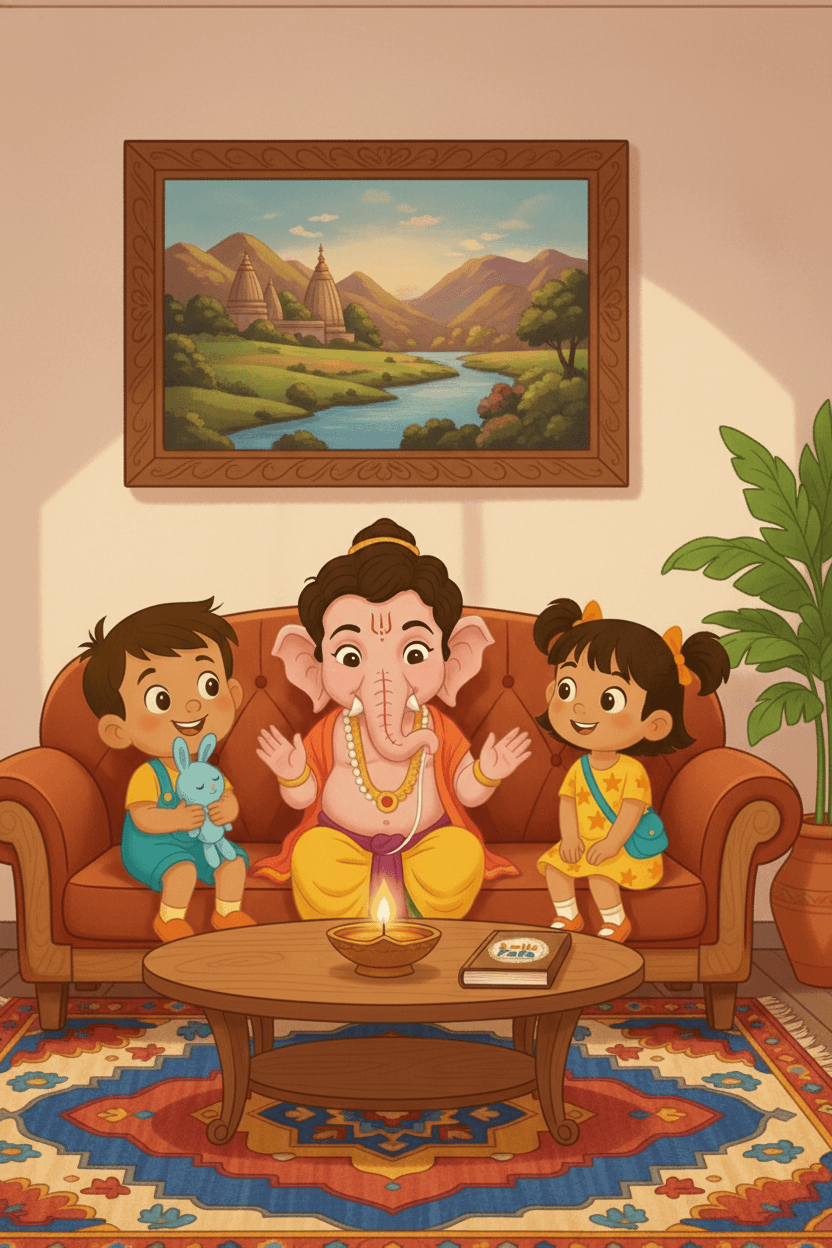
India has one of the world's richest storytelling traditions. Here's how to use it — practically, without being preachy — to raise children who carry these values naturally.
Every culture teaches its values through stories. The Greeks had Aesop. The Norse had the Eddas. And India — with thousands of years of the Panchatantra, the Jataka Tales, the Mahabharata, the Ramayana, and a thousand regional oral traditions — has perhaps the richest storytelling heritage in human history.
But here's the thing about teaching values through stories: it only works when the story comes first and the lesson comes second. The moment a child senses they're being lectured, they stop listening. The values have to emerge naturally from what happens in the narrative — not be announced at the end like a disclaimer.
Here are ten values that matter deeply in Indian families, how to weave them into stories your child will actually want to hear, and why stories are the most effective vehicle for each one.
Why stories work when instruction doesn't
Before the list: it's worth understanding the mechanism. Psychologists use the term "narrative transportation" to describe what happens when a child is absorbed in a story — their brain begins processing fictional events as real experiences. This means that a character's act of courage is experienced by the child, not just observed. An emotional memory is created. And emotional memories shape behaviour far more powerfully than rules ever do.
India's storytelling tradition understood this intuitively. The Panchatantra embeds its lessons so deeply in narrative that children receive the value as experience first, and only recognise the lesson afterwards. That self-discovery is what makes it last. A lesson a child finds themselves is a lesson they own.
1. Respect for elders (Aadar)
The least effective approach: a story where a child is scolded for being disrespectful and learns their lesson. The most effective approach: a story where a grandparent holds a piece of knowledge no one else has — knowledge that solves the entire problem. Let the elder be genuinely wise and useful, not just old and in need of deference. Respect follows naturally from admiration. Children learn to revere what they have seen to be valuable.
Story structure that works: The family is stuck — a journey has gone wrong, a festival is about to be ruined, a friend is in trouble. No one knows what to do. The grandfather or grandmother, sitting quietly to one side, mentions something they remember. That memory contains the answer. The elder's knowledge saves the day.
2. Sharing and generosity (Daan)
The Panchatantra is full of these. The most effective generosity stories frame it not as sacrifice but as intelligence — the character who shares ends up with more: more friends, more safety, more happiness. The character who hoards ends up alone. This is not moralising; it's showing how generosity works in practice. Make generosity feel smart, not saintly.
What to avoid: Stories where the generous character is rewarded by a magical being. This displaces the reward from the act to the magic, and children notice. The warmth of having shared, shown through the responses of other characters and the feeling inside the generous one, is a more credible and more lasting reward.
3. Perseverance (Dhairya)
Stories about characters who fail multiple times before succeeding are more powerful than stories about natural talent. Natural talent is not something children can choose; perseverance is. A child who hears about their own character — someone with their name — trying and failing and trying again internalises that resilience is the point, not the outcome.
The key detail: the character must genuinely consider giving up. They must feel the pull of quitting. And then, for a reason that is real rather than convenient, they choose to try once more. That moment of re-choosing is what the child experiences — and that is the value being transmitted.
4. Honesty (Satya)
The classic Panchatantra approach: a character lies, the lie requires another lie to maintain, the web of lies makes everything worse, and the truth eventually comes out and is far less costly than the lies became. Don't make honesty about moral virtue. Make it about practical wisdom — truth is simpler to maintain, and easier in the end. Children find this argument more compelling than the abstract claim that honesty is right.
5. Care for nature (Prakriti prem)
Indian mythology is full of human-nature interdependence. Rivers have names. Trees have spirits. Animals are divine vehicles. This isn't superstition — it's a cultural model of reciprocal relationship with the natural world that has enormous practical wisdom behind it.
Stories that place children in relationship with nature — where helping a river or a tree has real consequences for the community, where harming a forest creature creates a cost — build environmental empathy far more effectively than lectures about climate change or extinction statistics. The child who grew up hearing that the river has a name, and a personality, and notices when it is treated well, will be different from the child who did not.
6. Humility (Vinaya)
The most memorable humility stories in Indian tradition involve characters who are clearly the most powerful or talented — but who choose not to show it. Hanuman knowing his own strength but not needing to prove it. The scholar who bows to the child who teaches them something. Make humility look like what it actually is: confidence secure enough not to need display. Children who see humility as weakness will resist it; children who see it as quiet strength will aspire to it.
7. Community over self (Samaj)
Stories where the protagonist realises their individual success is hollow without the community are powerful from age 6 upwards. The most effective version: the child wins the race, or solves the puzzle, or reaches the top first — and notices that the celebration feels wrong without their friend who is still struggling behind them. They go back. They help. And the shared celebration at the end is richer than any individual victory. This is the value that Indian philosophy puts at the centre; the story makes the child feel why.
8. Courage (Sahasa)
The crucial detail in courage stories: the character must be afraid. Courage that isn't afraid isn't courage — it's recklessness, and children know the difference. The most powerful version shows a child-like character who is genuinely scared, who wants to turn back, who feels their heart doing something unpleasant — and who takes the next step anyway. That is the courage that is useful in real life. And that is the courage that children internalise as identity when they hear a version of themselves demonstrate it in a story.
9. Gratitude (Kritagyata)
Stories where a character forgets to be grateful and notices what they've lost are more powerful than stories where a character is rewarded for gratitude. Loss is a more visceral teacher than reward. End on restoration — the character recognises what they had, gives thanks, and it returns or is honoured — but let the middle be a genuine reckoning with what absence feels like. Children who have felt, vicariously, the cost of ingratitude, understand gratitude as more than politeness.
10. Ahimsa (Non-harming)
The richest vein of Indian storytelling, and the most intellectually demanding value to transmit through story. Stories where the character finds a way to solve a problem without harming anyone — including the antagonist — teach creative problem-solving alongside the ethical principle. The solution must feel genuinely clever, not conveniently easy. The best Jataka Tales do this masterfully: the solution is always unexpected and always kind, and the surprise of the kindness is itself part of the lesson. The child thinks: I would not have thought of that. I want to be someone who would think of that.
Age-specific guidance
Ages 2–4: Keep it physical and immediate. Sharing a toy, being gentle with an animal, helping someone who has fallen. Abstract values (community, humility) are too conceptually distant at this age. The emotional experience — warmth of giving, comfort of being helped — is what matters.
Ages 4–7: Empathy develops robustly in this window, making it the ideal time for stories about noticing others' inner lives. This is when Panchatantra-style tales, where the character's understanding of another's situation changes everything, are most effective.
Ages 7–10: Moral complexity becomes possible. Stories where the right choice is difficult, unpopular, or costly — where courage means something — resonate at this age. Children at this stage are navigating real peer dynamics and appreciate stories that model integrity under pressure.
The personalisation advantage
The most powerful thing you can do is put your child into these stories. Not as a passive recipient of someone else's adventure, but as the character who chooses to share, who has the courage to be honest, who stops to help the friend who fell behind.
When the character in the story has your child's name and your child's favourite colour and your child's specific way of approaching the world — and that character demonstrates a value you want to nurture — the story stops being a story about someone else. It becomes a story about who your child already is. That distinction is everything. A value demonstrated by someone else is an observation. A value demonstrated by a version of yourself is evidence.
That is the real magic of India's storytelling tradition. It was never about entertainment alone. It was always about shaping the person who listened.
Common questions
How can Indian parents teach values to children through stories?
The most effective approach is to let the story come first and the lesson second — so naturally that the child does not realise they have received one. Stories from the Panchatantra, Jataka Tales, and Indian oral traditions work because they embed values like honesty, generosity, and courage in vivid narrative situations rather than announcing them as morals. The child experiences the value through a character's choice, which is far more lasting than being told what is right.
What Indian values can be taught through children's stories?
The richest terrain includes respect for elders through stories where an elder's wisdom solves the problem, generosity shown as practically intelligent rather than just virtuous, courage where the character is genuinely afraid and acts anyway, ahimsa where the solution is always unexpected and kind, community over self where individual success feels hollow without togetherness, and gratitude where a character notices the cost of forgetting it. The key with all of them is showing the value in action rather than stating it as a principle.
Why is the Panchatantra good for children?
The Panchatantra is one of the world's oldest collections of fables designed specifically to teach values through animals and adventure. Its stories work because they embed practical lessons — honesty, loyalty, the consequences of greed — in entertaining plots with memorable characters, rather than presenting wisdom as abstract instruction. The lessons arrive as story first; the principle crystallises only afterwards. That is exactly the right order for young minds, and it is why these stories have been told for over two thousand years.
At what age should children start hearing Indian value stories?
From age 2, with age-appropriate design. Toddlers respond best to values shown through physical, observable acts — sharing a toy, being gentle with an animal. Abstract values like community or humility require developmental capacity that emerges around age 4 to 5. Empathy-based values — noticing and responding to others' inner lives — are most powerfully transmitted between ages 4 and 7. Moral complexity, where the right choice is difficult or unpopular, becomes accessible from around age 7.
How does ahimsa translate into a children's story?
The most effective ahimsa stories present the character with a problem where the obvious solution would involve harming someone — even the antagonist — and then show them finding an unexpected, kind solution instead. The solution must feel genuinely clever, not conveniently easy, or the child will not experience the value as aspirational. The best Jataka Tales do this: the resolution is always surprising and always kind, and the surprise of the kindness is itself part of what the child remembers. They think: I would not have thought of that. I want to be someone who would.
Why do personalised Indian value stories work better than generic ones?
Because a value demonstrated by someone else is an observation, but a value demonstrated by a version of yourself is evidence. When the character in the story shares the child's name, interests, and personality — and that character chooses courage or honesty or generosity — the child experiences the value as something they have done, not something they have watched. This is the self-referential processing effect: information connected to the self is integrated more deeply into self-concept. The story becomes narrative evidence of who the child already is.
Raj Kothari
Founder, Lalli Fafa — building magical, personalised stories for children across India.
Put this into practice tonight
Create a personalised story for your child — free, in under 2 minutes.