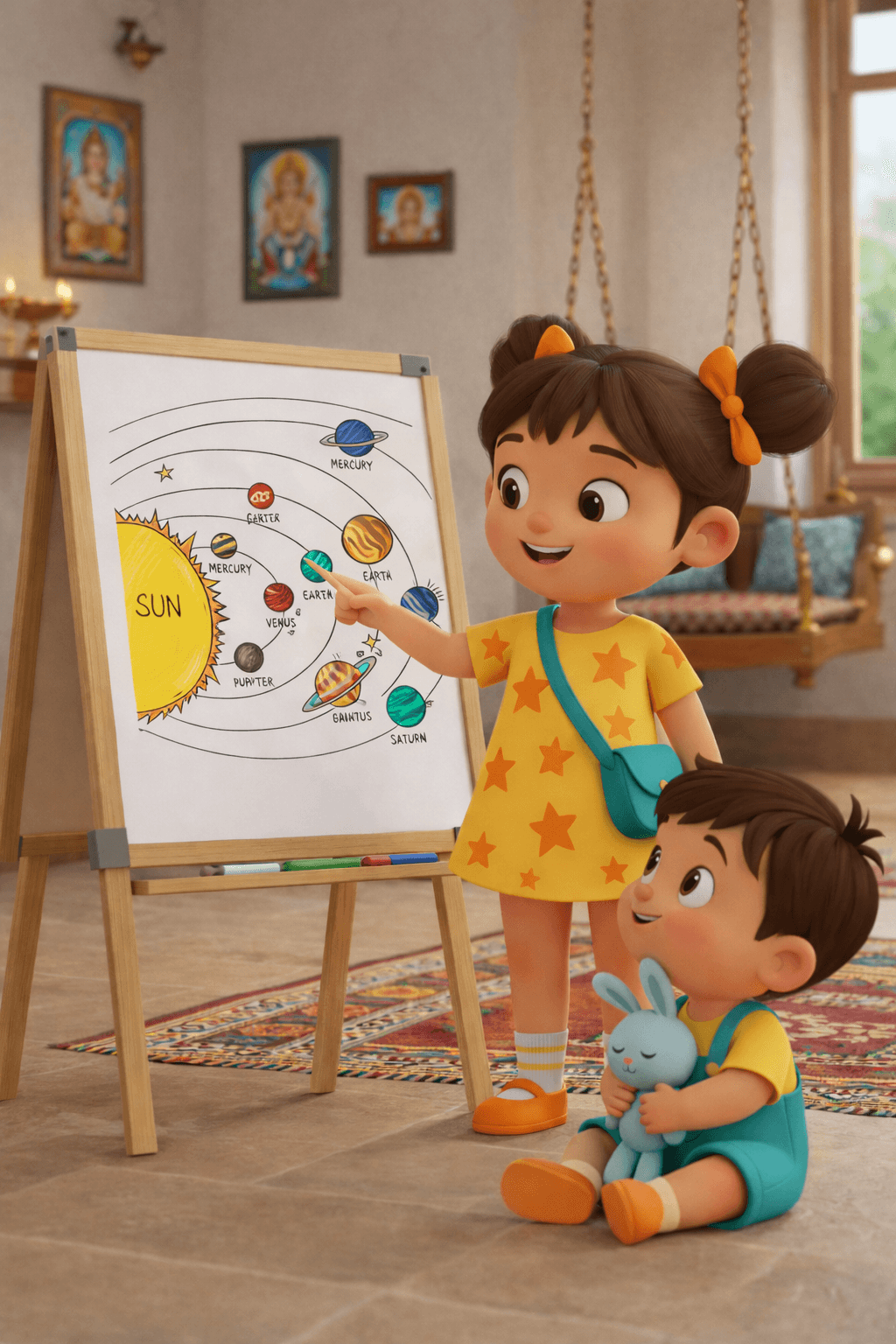
AI-generated children's stories could easily feel mechanical and hollow. Here's how we think about the problem — and what we do to make sure Lalli Fafa stories feel genuinely warm.
The first time we generated a children's story using AI, we were genuinely impressed — and a little unsettled. The story was technically correct. The sentences were clean. The moral was clear. And it felt completely hollow.
If you've ever read an AI-generated children's book, you may know the feeling. Something is off. The warmth is performed rather than felt. The characters have names but not personalities. The lesson is stated rather than discovered. You can read the whole thing and come away with nothing — no image lodged in memory, no feeling that sat with you.
We knew that building Lalli Fafa well meant solving this problem, not working around it. Here is how we approached it — and what we learned.
The "what" versus the "how"
The fundamental challenge with AI storytelling for children isn't the "what" — AI can generate plot structures, character arcs, and moral resolutions reliably well. The challenge is the "how": the specific texture of language that makes a story feel warm, the precise moment a character makes a choice that feels true, the detail that makes a child laugh or lean in.
Most AI children's stories get the "what" right and completely miss the "how." To see the difference concretely:
Hollow AI version: "Arjun was scared. He didn't know what to do. But then he remembered he was brave. He did the thing and felt better."
What we aim for: "Arjun's feet had gone very still, the way feet do when the rest of you isn't sure yet. The cave was dark and smelled like old mud and something interesting. He thought about turning back. Then he thought about Lalli's face if he did. He took one step. Then another. The interesting smell got stronger."
The first version tells you what happened. The second version takes you inside it. That difference is everything for a child at bedtime.
What we did about it
We spent months doing something unglamorous: reading. Children's books. Thousands of them — the classics, the overlooked, the translated-from-other-languages gems. We paid attention not to what happened in the stories, but how it was said — where the best authors slowed down, what they described and what they left to imagination, how they handled the moment of a character's decision.
A few patterns emerged that we built directly into how our system generates stories:
Specificity over generality
"The forest was beautiful" is generic. "The forest smelled like rain and the bark of the old neem tree that Rohan always touched on the way to school" is specific. Specificity is what makes fiction feel real — it signals to the reader's brain that someone who was actually there is describing it. We train our generation system to reach for the particular detail rather than the broad stroke, consistently.
Conflict before comfort
A story with no resistance is not a story — it's a sequence of events. Good children's stories, even very short ones, give the child-protagonist a real moment of difficulty before the resolution. Not trauma, but a genuine "what do I do now?" moment that the character has to navigate. This is what makes the ending earned rather than given. An ending the character didn't have to work for feels unearned to a child, even if they can't articulate why.
Show the feeling, name it second
The weakest AI stories tell emotions: "Priya felt scared." The best children's authors show them first — "Priya's stomach felt like it was full of butterflies doing somersaults" — and only then, if at all, name the emotion. This isn't a stylistic preference; it's how emotional vocabulary is actually built in children. When a feeling is shown in context before it's named, the child encodes both the experience and the word together, which produces real comprehension rather than just word recognition.
Language calibrated to age, not dumbed down
There's a meaningful difference between age-appropriate language and condescending language. Children's books don't need to avoid interesting words — in fact, a single, perfectly-placed unfamiliar word, contextually explained, is one of the most effective vocabulary-building tools that exists. Our stories are calibrated to the child's reading age without being stripped of richness. A four-year-old can handle "luminous" if the sentence makes it clear what it means.
Cultural calibration for Indian families
One thing that immediately distinguishes a story built for Indian children from a generic story: the specific textures of Indian life. A monsoon afternoon smells different from an English rainy day. A grandmother's kitchen sounds different. The kind of courage Lalli shows — practical, warm, resource-finding — is distinctly different from the heroic-quest courage of Western children's fiction.
We built these textures into our generation system deliberately. When a Lalli Fafa story is set in a market, it's a specific kind of market — the noise, the colours, the chai stall at the corner. When a character shows respect, it's the particular Indian way of showing respect, not a Western approximation of it. Stories that feel culturally familiar create stronger emotional resonance in children — the setting isn't exotic or unfamiliar, which means the child can spend all their attention on the emotional content rather than picturing the background.
The personalisation layer: where the warmth really comes from
Here's where the warmth really comes from: knowing your child. When Lalli Fafa generates a story for a six-year-old named Ishaan who loves dinosaurs and whose favourite colour is green, the story isn't generated with those as surface decorations. They're woven into the story's logic. Ishaan's dinosaur expertise becomes the thing that saves the day. The green detail appears at the moment it matters most — not sprinkled randomly.
This is the difference between personalisation that feels like mail-merge and personalisation that feels like someone wrote this for your child specifically. The test we use internally: if you removed the child's name and replaced it with "a child," would the story still make sense in exactly the same way? If yes, the personalisation isn't deep enough. The story should depend on the specific details of this specific child to reach its resolution.
The voice pipeline
A story that reads well on a page is not automatically a story that sounds warm when narrated. We designed four distinct character voices for Lalli Fafa — narrator, Lalli, Fafa, and the child's own character — each with its own tonal qualities. Lalli sounds assured and slightly older-than-she-is. Fafa sounds exactly as curious and round-vowelled as a three-year-old should. The narrator is warm and unhurried — the voice of someone who has time for this story, tonight, for this child.
Hindi narration was built as a first-class feature, not a translation. The Hindi voices were calibrated for natural cadence in Hindi — not English sentence rhythm translated into Hindi words. The difference is immediately audible and matters enormously for bilingual families who want their children to experience Hindi as a story language rather than an English story read aloud with Hindi sounds.
What AI genuinely can't do — and what we do about it
We are honest with ourselves about this. AI cannot replicate the specific warmth of a parent's voice reading a story. It cannot know that your child is afraid of thunder right now, or that they just had a hard day at school, or that the character named "Rohan" should be gentle and funny because that's what your child needs to see in a hero this week.
These things are yours to provide. What AI can do is give you a beautifully crafted, uniquely personalised story in two minutes — one that you then read to your child in your voice, with your warmth, at your pace. The AI is not the storyteller. You are. The AI is the writer who had a wonderful idea, and handed it to you.
That's a collaboration we feel good about. And the measure of whether it's working is not the story on the screen — it's the expression on your child's face when they hear their name in it for the first time.
Common questions
Why do AI-generated children's stories often feel hollow?
Most AI children's stories get the what right — the plot, the character arc, the moral — but miss the how: the specific texture of language that makes a story feel warm. They tell emotions rather than showing them, resolve conflicts without the genuine messiness that makes resolution satisfying, and generate characters with names but not personalities. The result is technically correct but emotionally empty — you can read the whole thing and come away with nothing that stayed.
What makes an AI children's story feel warm and human?
Specificity over generality, conflict before comfort, showing feelings before naming them, language calibrated to age without being condescending, and cultural textures that feel familiar rather than foreign. Beyond craft, genuine personalisation — where a child's interests and traits are woven into the story's logic rather than sprinkled as surface decoration — is what makes an AI story feel like it was written for your child specifically. The test: if you removed the child's name, would the story still work in exactly the same way? If yes, the personalisation isn't deep enough.
Can AI replace the warmth of a parent reading a bedtime story?
No — and good AI storytelling tools do not try to. A parent's voice, presence, and knowledge of their specific child is irreplaceable. What AI can do is give you a beautifully crafted, genuinely personalised story in two minutes — one that you then read to your child in your voice, at your pace. The AI is the writer; you are the storyteller. That collaboration is what makes it work.
How is Hindi narration handled in AI story apps?
The quality difference between well-built and poorly-built Hindi narration is immediately audible. Poorly built Hindi narration is English sentence rhythm translated into Hindi words — it sounds like someone reading a translation aloud. Well-built Hindi narration is calibrated for natural Hindi cadence from the ground up: different sentence structures, different emotional pacing, voices that sound like they grew up speaking Hindi. At Lalli Fafa, Hindi narration was designed as a first-class feature, not an afterthought — with four distinct character voices each calibrated for their role.
Why does cultural specificity matter in children's AI stories for Indian families?
Stories that feel culturally familiar create stronger emotional resonance — the child spends all their attention on the emotional content rather than making sense of an unfamiliar background. A monsoon afternoon, a grandmother's kitchen, the specific kind of courage that is practical and warm rather than heroic-quest — these textures make a story feel like it belongs to an Indian child's world. Generic children's stories, even well-crafted ones, require Indian children to do extra cognitive work to place themselves in the setting. Indian-specific details remove that barrier.
What is the difference between surface personalisation and deep personalisation in children's stories?
Surface personalisation is name-swap: a generic story template where the child's name is inserted in place of a generic character name. Deep personalisation is when the child's specific interests, traits, and details drive the story's logic — their love of elephants is what solves the problem, their favourite colour appears at the critical moment, their age-appropriate challenge is the one the story is built around. Surface personalisation produces a mildly flattering story. Deep personalisation produces the wide eyes and the 'how did it know?' reaction that parents describe.
Raj Kothari
Founder, Lalli Fafa — building magical, personalised stories for children across India.
Put this into practice tonight
Create a personalised story for your child — free, in under 2 minutes.