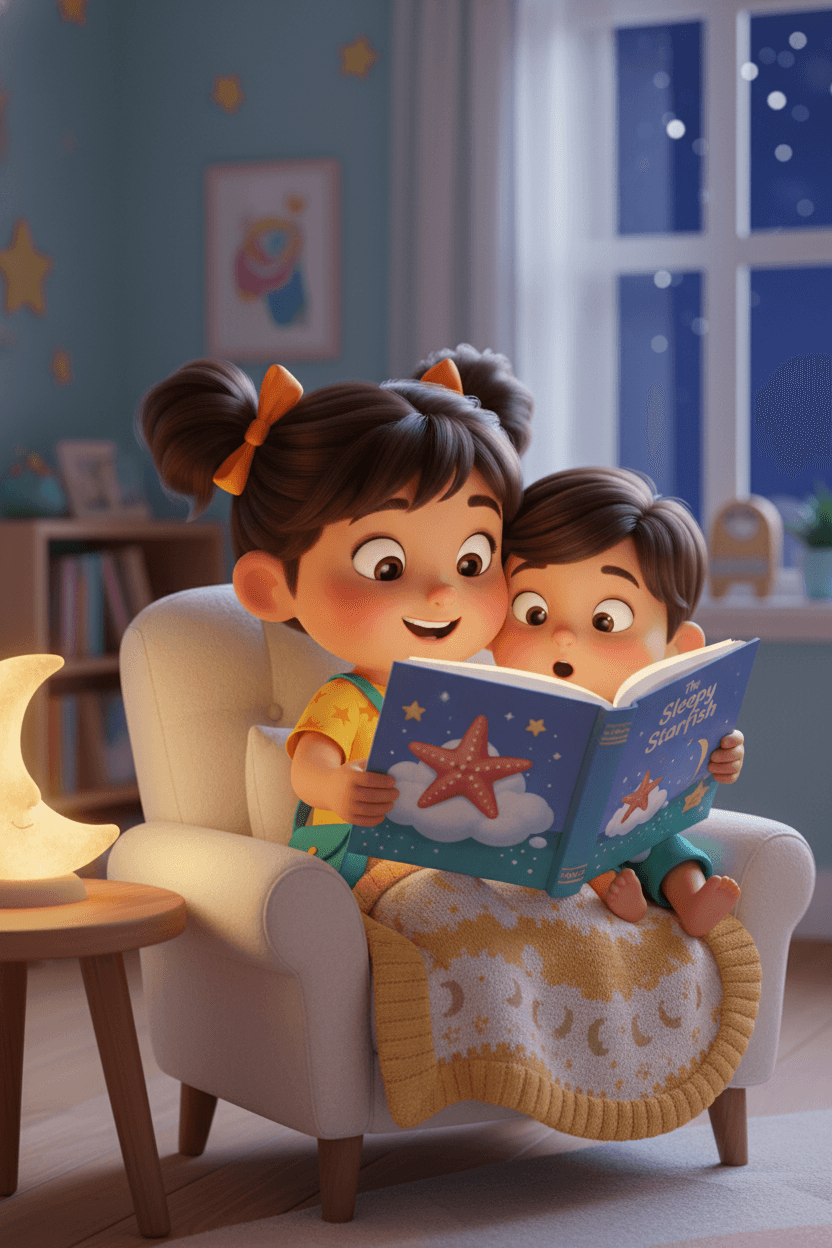
From newborns to eight-year-olds, stories do different things at different ages. Here's what the research says about when to start — and what kind of story works best at each stage.
Children can benefit from being read to from birth. Even newborns who cannot understand words respond to the rhythm, warmth, and pacing of a parent's voice during a story — and by three months, babies begin to distinguish familiar voices and sounds. There is no age too early to start, and there is no age at which stories stop being valuable.
That said, what a story does for a child changes significantly across the first eight years of life. The same bedtime story that soothes a one-year-old is teaching vocabulary to a three-year-old and building empathy in a seven-year-old. Understanding what happens at each stage helps you choose the right kind of story at the right time.
Birth to 12 months: rhythm, voice, and safety
Newborns cannot understand words, but they absolutely respond to stories. What they are processing is not meaning but pattern: the rhythm of sentences, the rise and fall of a familiar voice, the predictability of a repeated phrase. This early exposure does three things:
- It builds auditory memory — babies who hear the same stories repeatedly begin to recognise them by around three months.
- It associates language with safety — the parent's voice during story time is a comfort signal that many children carry into early childhood.
- It begins vocabulary exposure — even at three months, babies are building an internal "map" of the sounds their language uses, long before they can produce or understand words.
At this age, the format barely matters. A picture book, an audio story, a made-up story — all have value. What matters is the consistency of the ritual and the warmth of the delivery.
12 months to 3 years: vocabulary explosion
This is the stage at which stories become measurably powerful for language development. Between one and three years old, children are in the fastest language-learning window of their lives — acquiring three to five new words per day at peak. Stories are one of the primary mechanisms through which this happens.
The key difference from earlier stages: children at this age are now actively connecting words to meaning. When a story uses the word "luminous" and then says "it glowed like the moon," the child's brain makes a connection. When a character feels "nervous" and the story shows what nervous looks like, the child is building emotional vocabulary alongside descriptive vocabulary.
Research from the American Academy of Pediatrics (AAP) found that children read to regularly from early toddlerhood showed significantly larger vocabularies by age five — and the effect held across income levels and education backgrounds. Stories are one of the most vocabulary-efficient activities a parent can do with a child at this stage.
At this age, repetition is not a problem — it is the mechanism. Asking for the same story again and again is a child doing language work. Each repetition builds fluency with the words, deepens comprehension, and reinforces emotional processing of the story's themes.
3 to 5 years: narrative thinking and moral reasoning
By age three, children are starting to understand story structure — beginning, middle, end — even if they cannot articulate it. They begin to anticipate what happens next, to understand cause and effect ("Fafa opened the door because he heard a sound"), and to connect a character's actions to outcomes.
This is the age at which the content of the story starts to matter more than the format. Children at three to five are building their first frameworks for:
- Moral reasoning — "was that the right thing to do?" becomes a question they can engage with
- Empathy — following a character who is scared, lonely, or brave teaches children to imagine experiences different from their own
- Emotional vocabulary — stories that name emotions precisely give children the words for what they feel in real life
At this stage, personalisation starts to have a measurable effect. Research from the University of Toronto found that children aged four were significantly more engaged by stories in which their own name appeared, and were more likely to adopt the moral lesson of a story when the protagonist shared their name. This is why personalised stories — where the child is genuinely the hero — are particularly effective at this age for values-building, not just entertainment.
5 to 8 years: complexity, culture, and independent imagination
School-age children can follow longer narratives, hold multiple characters in mind, and begin to understand subtext — that a character might feel one thing but say another. Stories at this stage can be more complex: longer arcs, slower reveals, more nuanced moral questions.
This is also the age at which cultural and linguistic identity in stories becomes meaningful. Children aged five and above are beginning to construct a sense of who they are and where they come from. Stories that feature characters who look like them, speak their language, and live in familiar cultural contexts strengthen that developing identity in ways generic content cannot.
Bilingual families often find this the most effective age to introduce stories in both languages simultaneously — the child has enough language capability in each to follow the narrative, and the cultural grounding that comes with each language starts to feel personally significant rather than just a word-swap.
The one rule that applies at every age
Consistency beats perfection. A short, imperfect story every night is more valuable developmentally than an occasional long, beautifully produced one. The ritual itself — the signal that says "this is the time when stories happen" — builds the habit of imagination, the association of language with pleasure, and the sense of safety that makes children receptive to what a story is trying to teach.
Start as early as you can, stay as consistent as you can, and let the story do the rest.
Common questions
At what age should you start reading to a baby?
You can start reading to a baby from birth. Newborns cannot understand words, but they respond to the rhythm and sound of a parent's voice. By three months, babies begin to recognise familiar sounds and voices. Starting early builds auditory memory, associates language with comfort, and begins vocabulary exposure long before a child can speak.
Is it too early to read to a one-month-old?
No — it is never too early to read to a baby. A one-month-old won't understand the words, but they will respond to the familiar voice, the rhythm of the sentences, and the warmth of being held during the reading. This early exposure builds the foundation for language acquisition that accelerates dramatically between 12 and 36 months.
At what age do children understand stories?
Children begin to understand story structure — beginning, middle, end, cause and effect — from around age three. Before that, they absorb vocabulary, rhythm, and emotional tone from stories without following a plot. By age five, most children can follow a multi-character narrative and begin to engage with a story's moral or lesson.
How long should a bedtime story be for a toddler?
For children aged one to three, five to ten minutes is typically ideal. At this age, attention spans are short and the goal is rhythm, warmth, and vocabulary exposure — not plot complexity. Repeating the same short story multiple nights in a row is developmentally beneficial: each repetition builds fluency and comprehension in ways that a different story each night does not.
Do personalised stories work better for young children?
Research from the University of Toronto found that children aged four showed significantly higher engagement and greater retention of moral lessons in stories where their own name appeared as the protagonist. The effect is strongest between ages three and six, when children are building their self-concept and are particularly responsive to seeing themselves reflected in a narrative.
Raj Kothari
Founder, Lalli Fafa — building magical, personalised stories for children across India.
Put this into practice tonight
Create a personalised story for your child — free, in under 2 minutes.