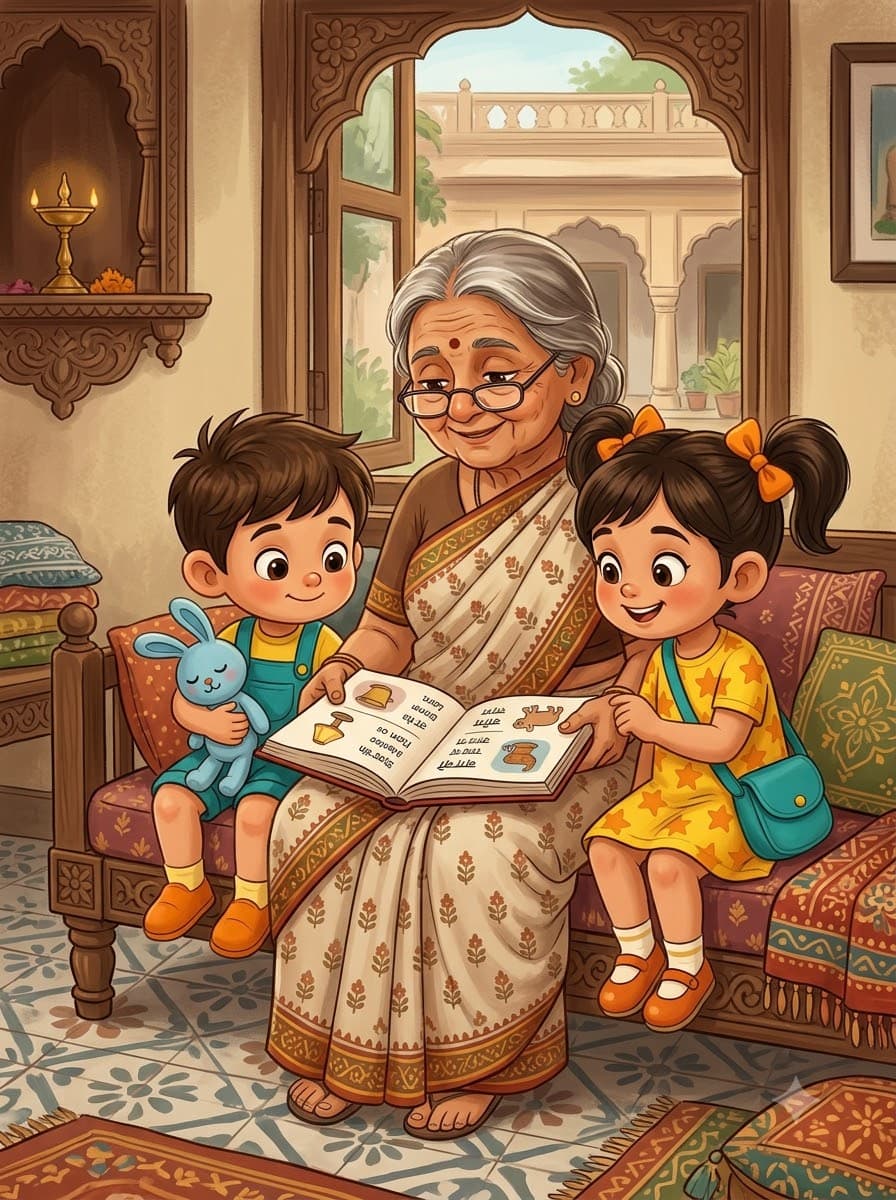
India's own National Education Policy makes the case for mother-tongue learning. Here's what that means in practice for bilingual families raising children on both Hindi and English.
India's own National Education Policy 2020 recommends that children be taught in their mother tongue or home language until at least Grade 5, and preferably Grade 8, a position UNESCO's 2025 "Bhasha Matters" report reaffirms directly, stating that education should begin in the learner's first language to support better understanding, cognitive development, and academic success. For bilingual Indian families raising children on both Hindi and English, this isn't just a cultural preference, it's aligned with the country's own education policy and with what the cognitive research on bilingualism shows.
This piece focuses specifically on families raising children in India, where the practical question usually isn't whether to expose a child to Hindi, it's how to make sure Hindi gets equal weight alongside English, given how much of daily life, schooling, and media already defaults to English. If you're raising a bilingual child outside India, we've written a separate, practically-focused guide for that situation in how to teach Hindi to kids growing up abroad. And if you want the deeper cognitive science on bilingualism generally, see do bilingual stories help with children's language development.
What India's own education policy actually says
NEP 2020 is explicit on this point: it recommends multilingual education, with initial learning in a child's home language, mother tongue, or a language familiar to the child, continuing until at least Grade 5 and preferably Grade 8. This isn't a fringe pedagogical opinion, it's the country's own stated policy position on how children learn best.
UNESCO's 2025 report on India, Bhasha Matters, examined how well that policy is actually reaching classrooms, and found a real gap: an estimated 44% of children in India face some kind of language mismatch at school, meaning the language of instruction isn't the language they're most comfortable in at home. The report's core finding is direct: education should begin in the learner's first language or mother tongue, to ensure better understanding, cognitive development, and academic success. Case studies cited in the report, drawn from tribal and rural contexts, found measurable improvements in reading comprehension, classroom participation, and conceptual understanding when schools embraced children's home languages.
For a family raising a child in a Hindi-English household, the practical read is straightforward: strengthening Hindi isn't at odds with strong English, and India's own policy research says the opposite is closer to true. Mother-tongue strength tends to support, not compete with, learning additional languages well.
What the cognitive research adds
Separately from the policy research, there's a well-established body of work on bilingualism and cognitive development. Research published in Cerebrum, the Dana Foundation's forum on brain science, found that bilingual children show stronger executive function, including better attention control and task-switching, than monolingual children, likely because managing two active language systems is itself a form of ongoing cognitive exercise.
We go deeper on this specific research, including phonological awareness and vocabulary breadth, in do bilingual stories help with children's language development, so we won't repeat it in full here. The short version: bilingualism is not a trade-off against cognitive development, it's associated with a specific cognitive advantage of its own.
Why stories specifically, not just conversation
Everyday conversation in any language tends to use a fairly narrow, repetitive vocabulary, the words needed to get through a day. Stories use a richer, more varied vocabulary, and for a bilingual child, hearing stories in both languages means encountering the literary register of each language, not just its conversational register.
This matters in a very specific way for many Indian households: children are often fluent in conversational Hindi, comfortable with everyday speech at home, but less exposed to Hindi in its richer, more expressive forms, the kind a story, a folk tale, or a well-narrated adventure uses. A Hindi story doesn't just add Hindi exposure, it adds a different, deeper kind of Hindi exposure than conversation alone provides.
Making it practical at home
A few things that make the biggest difference, drawing on both the policy research above and the practical experience of bilingual families:
- Native-quality narration matters more than translation. A story written and told in Hindi carries different rhythm and emotional weight than an English story translated and read aloud. Children notice the difference, even if they can't articulate it.
- Consistency beats occasional immersion. Ten minutes of Hindi story time most nights builds more than an occasional longer session.
- Let both languages carry real stories, not just labels. Naming objects in Hindi is useful, but a full story, with characters, feelings, and a real narrative arc, is what builds the literary register conversation alone doesn't reach.
This is exactly why Hindi narration was part of Lalli Fafa from the start, not translated subtitles over English audio, but genuinely native-quality Hindi storytelling, personalised around your child, so Hindi gets to be the language of adventure and imagination at home, not just the language of instructions. You can explore our Hindi story options directly on our Hindi stories page.
Common questions
Does India's National Education Policy support teaching children in Hindi?
Yes. NEP 2020 recommends that children be taught in their mother tongue, home language, or a language familiar to them for initial learning, continuing until at least Grade 5 and preferably Grade 8. UNESCO's 2025 Bhasha Matters report reaffirms this directly and found that a significant gap still exists between this policy and actual classroom practice in India.
Is it better for bilingual children to have stories in both languages, or should one language be prioritised?
Research supports both languages being genuinely present, not one at the expense of the other. Strength in a child's mother tongue tends to support rather than compete with learning additional languages well. Bilingual children raised with strong exposure to both languages, especially through rich, narrative content like stories, show benefits including stronger executive function and broader combined vocabulary.
Does bilingualism affect a child's cognitive development?
Research published in Cerebrum, the Dana Foundation's forum on brain science, found that bilingual children show stronger executive function, including better attention control and task-switching, than monolingual children. Managing two active language systems appears to function as an ongoing form of cognitive exercise.
Why do stories matter more than everyday conversation for learning Hindi?
Everyday conversation tends to use a narrow, repetitive vocabulary. Stories use a richer, more varied vocabulary and expose children to a language's literary register, its rhythms, expressions, and emotional vocabulary, not just its practical, conversational form. This matters especially for children who are conversationally fluent in Hindi at home but have limited exposure to its richer, more expressive forms.
What's the difference between raising a bilingual child in India versus abroad?
Families in India are usually managing an imbalance where English already dominates schooling and media, so the practical challenge is making sure Hindi gets equal weight, not introducing it from scratch. Families abroad are often working against much less daily Hindi exposure altogether. We cover the abroad-specific situation, including practical daily strategies, in a separate guide.
Raj Kothari
Founder, Lalli Fafa — building magical, personalised stories for children across India.
Put this into practice tonight
Create a personalised story for your child — free, in under 2 minutes.